Why Does My Voice Recording Sound Boxy in a Treated Room?
Oct 22, 2026
A treated room can still produce a voice recording that sounds boxy, hollow, or more distant than you expected.
That does not automatically mean your microphone is wrong or your acoustic panels are useless. It may mean the microphone, your position, and the treatment are not working together as well as they could.
When I evaluate a recording like this, I want to answer a practical question: how much of what the microphone captures is your direct voice, and how much is the room responding to it?
That is a more useful starting point than deciding which piece of equipment to replace.
A room can have treatment and still have a recording problem
In one voice-capture coaching session, the person I was working with already had capable equipment and acoustic treatment. The conversation was not about starting over with an empty room.
We were looking at how to use what was already there.
The raw recording contained room coloration that was making the processing work harder than I wanted. We discussed the microphone’s position, the direction it faced, and whether the available panels were controlling the reflections reaching it.
The next step was to try different configurations and compare recordings.
That is an important distinction. Having acoustic treatment in the room is not the same as knowing that the treatment is helping the microphone in its current position.
Listen from the microphone’s perspective
You experience the room from where your ears are. Your microphone captures it from somewhere else.
It is also responding according to its pickup pattern and the frequencies arriving at it. A room that seems comfortable when you are sitting at your desk may still contribute an unwanted sound to the recording.
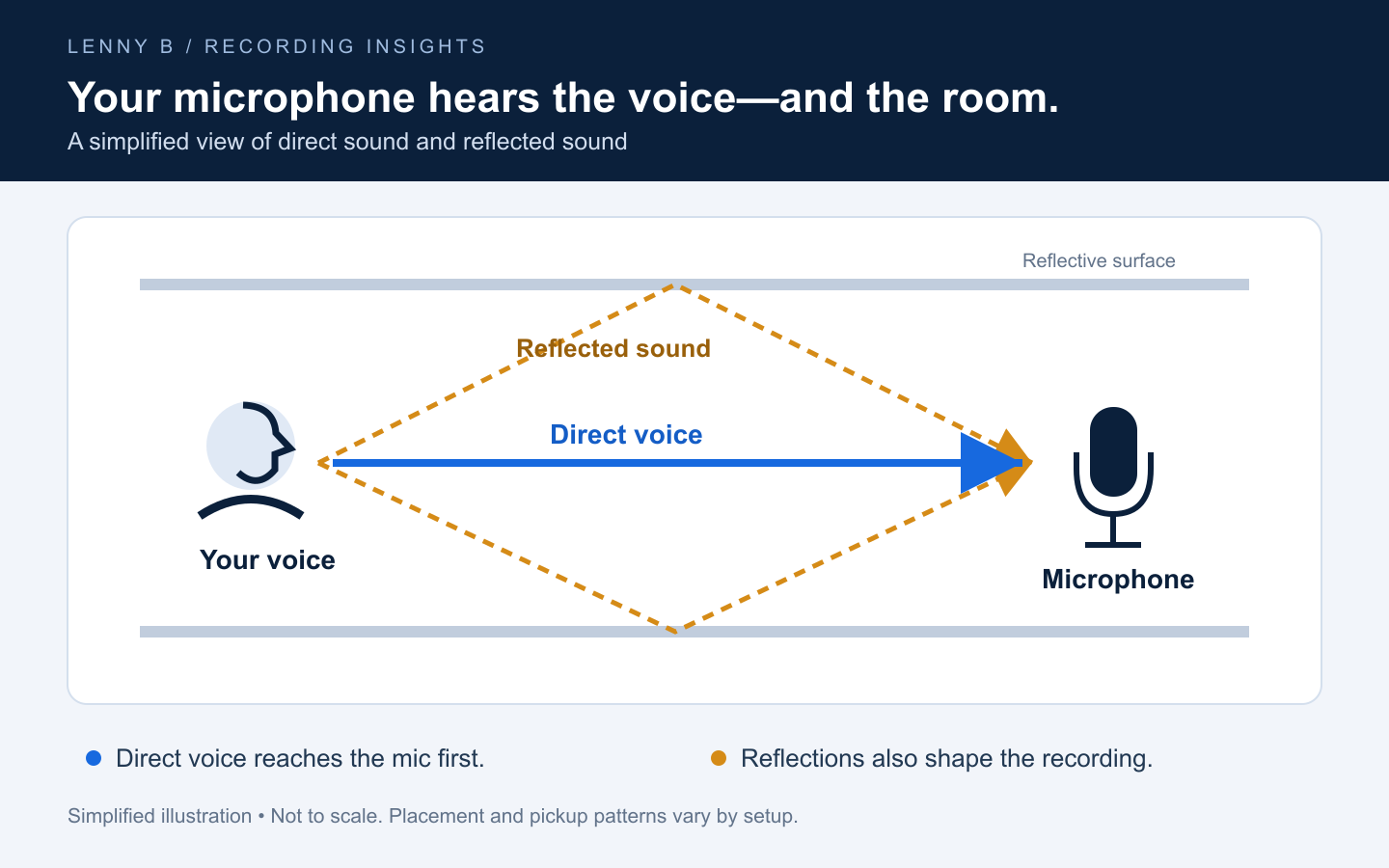
Your voice travels directly to the microphone, but it also travels into the room. Some of that sound reflects from surfaces and reaches the microphone afterward.
Those reflections can change the character of the recorded voice. You may hear them as a hollow quality, a boxy sound, or a sense that the voice is farther away than it should be.
My goal is to capture more direct voice and less distracting reflected sound. The raw recording is where I want to evaluate that balance.
Try placement before committing to more treatment
In that coaching conversation, I suggested experimenting with the panels before permanently mounting anything in a new location.
There is a useful reason for doing that: you want to hear whether a change helps before you commit the room to it.
You might discover that repositioning an existing panel makes a more useful difference than adding another panel somewhere else. You might find that a different recording position changes the sound more than you expected.
That does not mean placement solves every acoustic problem. The type and thickness of the treatment still matter, and different rooms need different solutions.
It means you can gather useful information before making the next purchase.
Make recordings you can actually compare
Here is a practical way to organize that experiment.
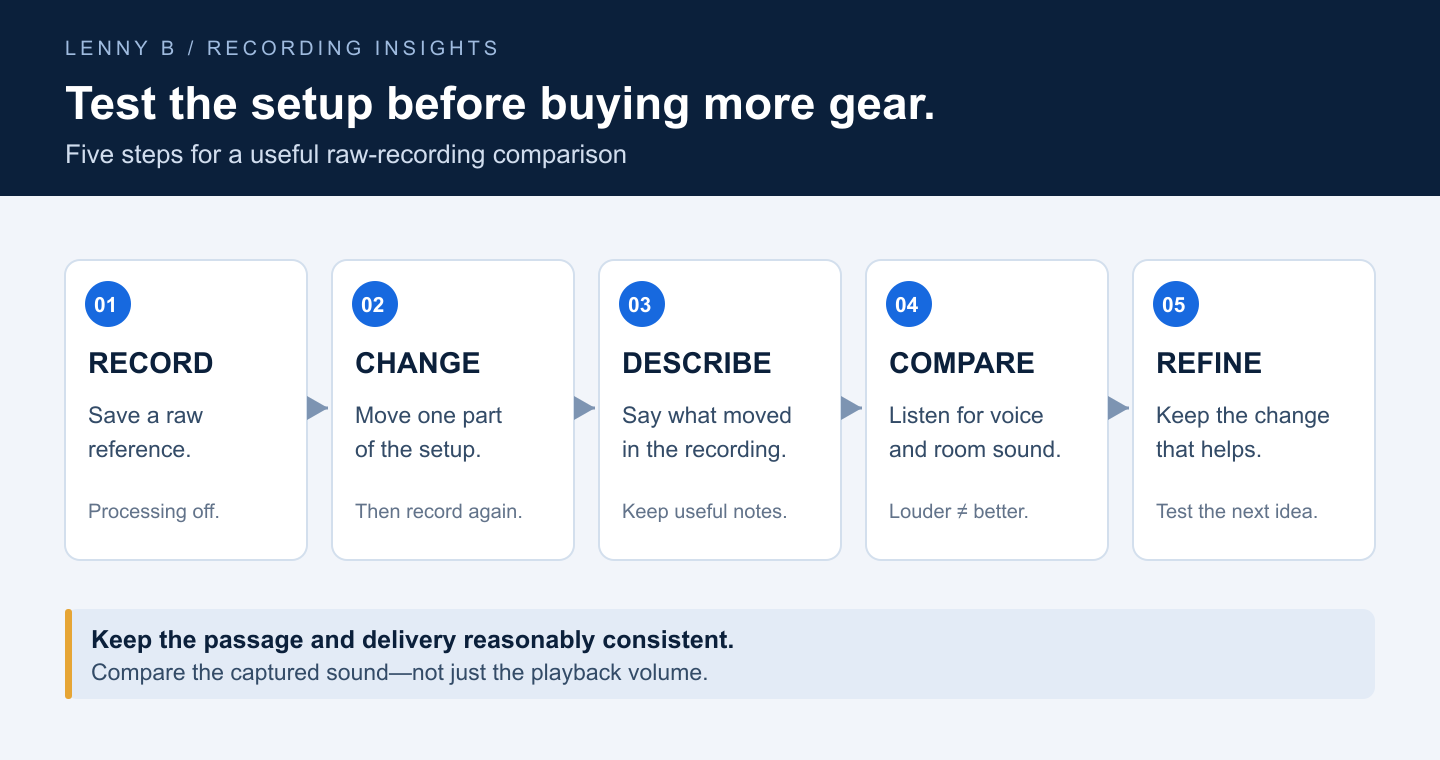
Start with a raw reference recording. Use your normal setup and leave the processing off. Record a short passage so you have a clear reference for what you are trying to improve.
Change one thing, then record again. Try a different microphone or recording position, or reposition a panel. Keep the spoken passage and your delivery reasonably consistent so the comparison is useful.
Describe the setup in the recording. This was one of my specific suggestions during the session. Say what you moved and where it is now. “Test two” is much less useful later than a description of the actual arrangement.
Listen for the voice and the room separately. Does the voice sound more direct? Is the hollow quality reduced? Did you introduce a different problem? You are looking for an improvement in the captured sound, not simply a louder playback.
Keep the useful changes and refine them. You do not need to solve the entire room in one move. A comparison can help you decide which direction deserves another test.
There is no universal placement diagram that guarantees the best result in every room. The recordings help us decide what is working in yours.
Room reflections and outside noise need different attention
It is also useful to separate room coloration from sound entering the recording space.
Acoustic treatment helps control sound within the room. Sound isolation concerns sound passing into or out of it.
If the problem is traffic entering through a window, moving an absorption panel may not solve the underlying noise problem. If the problem is your voice reflecting around the room, treating it only as an outside-noise issue sends you in the wrong direction.
Both can be present. The first job is to identify what you are hearing.
Keep the setup practical
A configuration also needs to work for the way you record every day.
During the coaching session, we talked about balancing the sound with the ability to use the room comfortably. An arrangement that requires stepping over equipment or working in an awkward position may be difficult to maintain.
The goal is a setup you can use consistently.
That consistency matters when we move into processing, too. A custom processing chain is built around the recording you feed into it. A more stable raw recording gives us a stronger foundation for shaping the finished sound.
If you want more context, I explain that relationship in Do You Need Better Recording Technique, Better Processing, or Both?.
Not sure whether you are hearing the room or the processing?
Send me a raw voice recording using the instructions on my submission page.
I’ll personally review it and either create a free custom-processed example or explain what to improve in the raw recording first. There is no cost and no obligation.
That gives us a starting point for deciding whether personalized processing, a voice-capture session, or another next step makes sense for your recording.