Do You Need Better Recording Technique, Better Processing, or Both?
Aug 13, 2026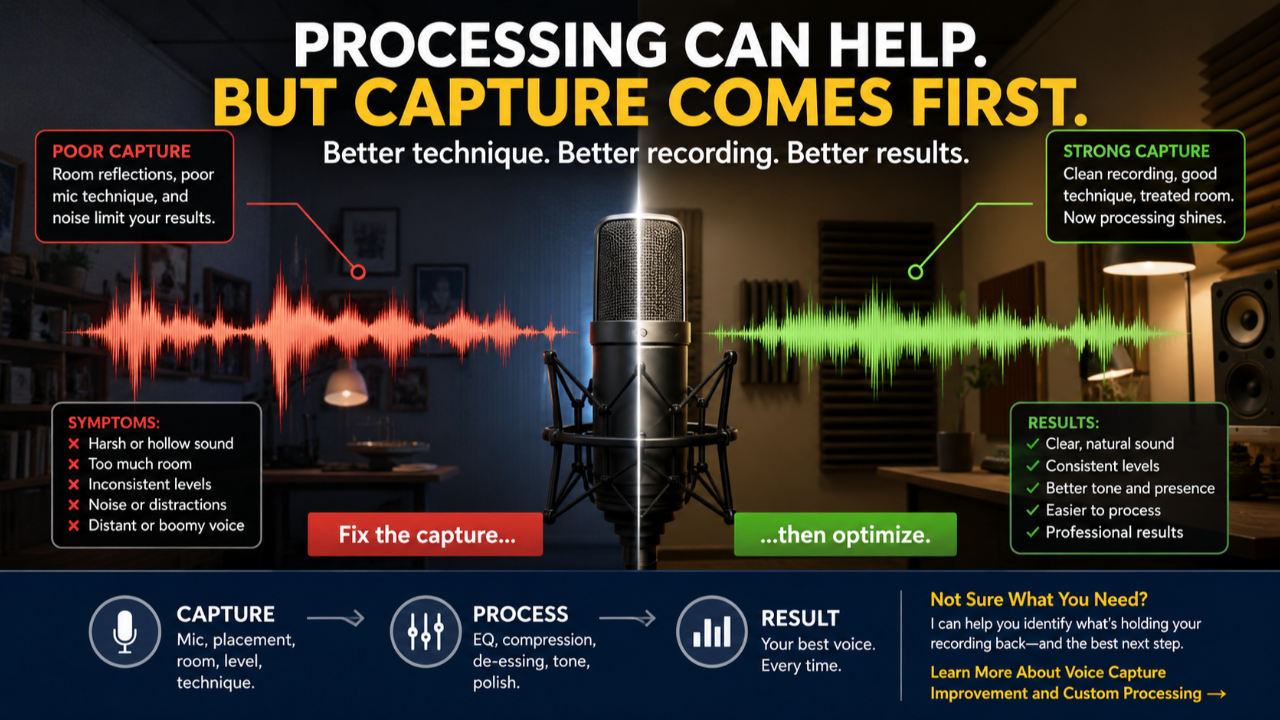
One of the most common problems I hear from voice actors is this:
They know their recordings don’t sound quite right, but they’re not sure why.
Maybe the voice sounds distant, boxy, harsh, thin, inconsistent, noisy, or overly reflective. Sometimes the assumption is that better processing will solve it. Other times, the instinct is to buy a different microphone, add another plugin, or change settings.
But before any of those decisions make sense, there is a more important question:
Is the problem happening during the recording—or after the recording?
That distinction matters because processing can improve a good recording dramatically, but it cannot completely rescue a poor raw voice capture.
The Difference Between Capture and Processing
When I talk about voice capture, I mean everything that happens before the audio reaches your processing chain.
That includes:
- Your microphone position
- Your distance from the microphone
- Your recording level
- Your room and acoustic treatment
- Reflections from nearby walls, desks, monitors, windows, or ceilings
- Background noise
- Your microphone and interface
- How consistently you perform into the microphone
Processing happens afterward.
That may include EQ, compression, de-essing, noise reduction, limiting, tonal shaping, and other tools used to make the voice sound more polished, controlled, and consistent.
Both matter.
But they solve different problems.
Processing Cannot Remove the Room
This is where many people run into trouble.
Imagine your microphone is capturing a noticeable amount of room reflection along with your voice.
EQ might make the recording brighter or darker.
Compression might make the level more consistent.
Noise reduction might reduce certain background sounds.
But none of those tools can truly turn a reflective recording into a clean, intimate recording that was captured correctly in the first place.
In fact, processing can sometimes make the problem more noticeable.
Compression is a good example.
Compression can help control dynamics and make a voice feel more consistent and finished. But if the original recording contains too much room sound, compression may bring that room sound forward along with the voice.
The processor is doing exactly what it is supposed to do.
The raw recording simply contains information we would rather not amplify.
A Better Preset Is Not Always the First Answer
When someone sends me audio for a Custom Processing Preset, one of the first things I listen for is whether the raw recording gives me enough quality to work with.
Sometimes it does.
The recording may already be clean and controlled, but the voice needs better tonal balance, smoother dynamics, less harshness, better presence, or more consistency.
That is an ideal processing problem.
Other times, I hear something different.
The microphone may be too far away.
There may be strong reflections in the room.
The recording level may be inconsistent.
The voice may be hitting the microphone at an angle that creates unnecessary harshness or sibilance.
In those situations, creating a more aggressive processing chain is not necessarily the responsible solution.
The better answer may be to improve the capture first.
How Do You Know Which Problem You Have?
Here are a few broad indicators.
If your recording sounds relatively clean and intimate before processing, but lacks polish, consistency, balance, or presence, processing may be the primary issue.
If the raw recording already sounds distant, hollow, highly reflective, distorted, unusually noisy, or inconsistent, capture probably needs attention first.
And sometimes the answer is both.
That is extremely common.
A few small improvements to microphone placement or the recording environment can produce a much stronger raw recording. Once that foundation improves, a properly designed processing chain can do far more.
This is why I often think of voice production in two stages:
First, capture the best version of the voice you reasonably can.
Then, use processing to optimize it.
You May Not Need to Rebuild Your Studio
Improving voice capture does not automatically mean buying expensive equipment or constructing a professional booth.
Often the highest-value changes are much smaller.
Moving the microphone a few inches can matter.
Changing the microphone angle can matter.
Moving away from a reflective surface can matter.
Adjusting where you sit in the room can matter.
Correcting recording level can matter.
Adding treatment in the right location can matter much more than adding treatment everywhere.
The goal is not perfection.
The goal is to stop asking processing to solve problems that are better solved before the processing begins.
When a Voice Capture Improvement Session Makes Sense
If your recording needs improvement before a custom processing setup can do its best work, that is exactly what my Voice Capture Improvement Session is designed to address.
We look at the actual recording environment, microphone position, recording level, signal path, and the problems I hear in your audio.
The goal is to make practical improvements to the raw voice capture so that what comes out of the microphone is already much closer to where it needs to be.
Then processing becomes much more effective.
For some people, improving capture is the next step.
For others, their capture is already strong and the real opportunity is personalized processing.
The important thing is knowing which problem you are actually trying to solve.
The Best Processing Starts With the Right Diagnosis
It is easy to keep adding plugins, changing microphones, or copying settings from someone else.
But voice recordings usually improve faster when you first identify where the weakness is entering the signal chain.
If it is happening during capture, fix the capture.
If the recording is already strong but lacks polish, improve the processing.
If both need attention, solve them in the right order.
That is usually the shortest path to a voice recording that sounds cleaner, more professional, and much more like the sound you were trying to achieve in the first place.