
Stop Editing Every Breath: How to Know When Your Recording Is Finished
Nov 09, 2026
You finish a voice recording, zoom into the waveform, and notice a breath. Then another. A tiny sound between words. A pause that suddenly looks too long.
Before you know it, you're fixing things you weren't bothered by when you listened.
How do you know when you're finished?
Start with what the person listening experiences
Your audience doesn't see your waveform. They hear your words, your delivery, and whatever else comes through the recording.
That might be a casting director considering an audition, someone listening to an audiobook, a podcast listener, or a potential customer watching your video. The question is whether something in the recording pulls their attention away from what you're saying.
Seeing a breath is a reason to listen. It isn't automatically a reason to remove it.
What I call the final listen
This question comes up in my work with clients: should I remove that sound, or is it okay?
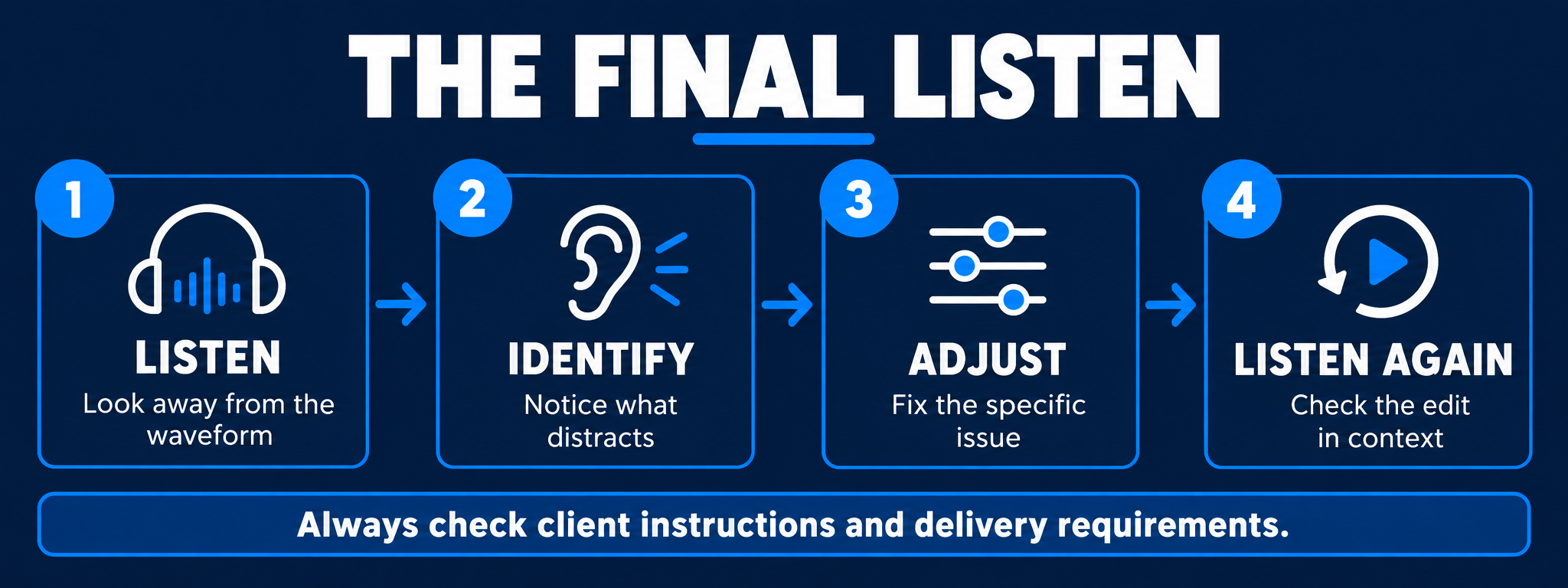
When I've finished a recording, I do something simple. I stop looking at the screen. Sometimes I close my eyes and imagine being the person listening somewhere else, following the story rather than examining the recording.
Then I listen all the way through.
If something bothers me—something that interrupts the words or draws my attention away from the performance—I go back and address it. If it doesn't, I don't keep editing simply because I can see something on the screen.
Addressing a sound doesn't always mean removing it. Sometimes turning it down, softening it, or reducing its prominence is enough. The useful question is how much adjustment the recording actually needs.
That's my final listen. It gives me a practical reason for making an edit.
Should you remove every breath?
I wouldn't make that decision with a blanket rule.
Breathing is part of human communication. A breath can carry the phrasing and feeling of a spoken performance. In singing, it can also contribute to the rhythm, cadence, or emotional feel of a song. Another breath might jump out so much that it's the thing you notice instead of the next sentence.
Breaths, mouth clicks, pops, and other sounds aren't automatically a problem just because they aren't the words themselves. Listen to their role in the recording. A prominent mouth click or pop may need attention, but its presence alone doesn't tell you whether to reduce it, remove it, or leave it alone.
Listen to what that particular breath is doing in that particular recording. Does it distract? Does it interrupt the intended flow? Or does it belong naturally with the words?
The goal isn't to leave every breath in. It isn't to remove every breath either. It's to make a deliberate choice that serves the recording.
After an adjustment, listen again in context. A repair needs to improve the experience, not just make the waveform look cleaner.
Finished depends on the production
A 15-second movie-trailer announcement may need a different level of finishing than a conversational video, a podcast, or a story. In a tightly produced spot, every breath, pause, and transition may need careful attention to serve the timing and style of the production.
If you’re creating content or telling a story, and the assignment doesn’t specifically call for flawless audio, you usually don’t need to keep polishing every tiny detail. Most of the time, the recording is finished when the message is clear and nothing in the audio distracts from the story or the experience you want the listener to have.
The same idea applies to texture. Some music-production plugins deliberately add noise and artifacts to evoke a vintage recording, a Motown-inspired sound, or a lo-fi aesthetic. Those sounds can be part of the creative choice, rather than something to clean away.
Perfectly clean, crystal-clear audio isn't always the right fit. Editing everything toward a sanitized or sterile result can work against the character of the performance. The target is the sound that serves the project.
Start with the kind of production you’re making and the standard it needs to meet. Your client’s instructions are part of that decision.
If you've agreed to remove breaths, meet a timing requirement, or deliver a particular format and loudness, a comfortable listen doesn't replace those requirements. Clarify the expectations before doing the work, then check that you've met them.
This listening approach helps with judgment. It doesn't replace the technical checks or agreed edits.
Give yourself a clear finishing process
Try this:
- Confirm the script, selected takes, and required edits are correct.
- Listen through without watching the waveform.
- Mark specific sounds that distract from the message.
- Reduce, soften, or remove those sounds as needed, then listen to the surrounding passage again.
- Check the delivery requirements and the final exported file.
If you're still organizing the larger process, my voice-over production workflow article explains the roles of recording, editing, processing, and final loudness.
The final listen is one more opportunity to experience the finished work as a listener.
Finish the recording so the message can do its job
You can spend a lot of time looking for one more thing to fix.
I'd rather you understand what needs attention, make the improvement, and get back to communicating something worth hearing.
If you're unsure whether your recording, processing, or workflow is holding you back, tell me what you're working on at LennyB.com. You'll find the ways we can work together there.