How to Choose the Best Microphone for Voiceover—Without Getting Stuck Choosing
Oct 22, 2026
Imagine making a reservation at a restaurant, arriving hungry, and discovering that the chef hasn’t started cooking.
He’s still researching knives.
He’s comparing brands, watching reviews, and wondering whether the more expensive knife would help him prepare a better dinner.
Meanwhile, you’re waiting to eat.
I think about this when people get stuck trying to choose the best microphone for voiceover. There’s a point where researching the equipment stops helping you make better recordings and starts keeping you from making recordings at all.
Your microphone is the chef’s knife. It needs to do its job. But someone is waiting for what you’re going to make with it.
Who are you recording for?
For an audiobook narrator, that person is the listener who wants to get lost in the story.
For a voice actor submitting an audition, it might be the casting director listening for a believable performance that fits the project.
For a YouTube creator, it’s the viewer who came to learn something, be entertained, or find an answer. For a podcaster, it’s the listener who wants an interesting conversation or a perspective worth returning for.
You might be recording training material, presenting your business, or helping a potential customer understand something.
In each case, there’s a person on the other end. Your recording needs to serve that person.
When you leave a great restaurant, you remember the food, the service, and how the experience made you feel. You might recommend it to a friend. You might make another reservation.
You have no idea whether the chef used a hand-forged Japanese knife or an expensive German chef’s knife. You didn’t come for the knife. You came for a meal worth remembering.
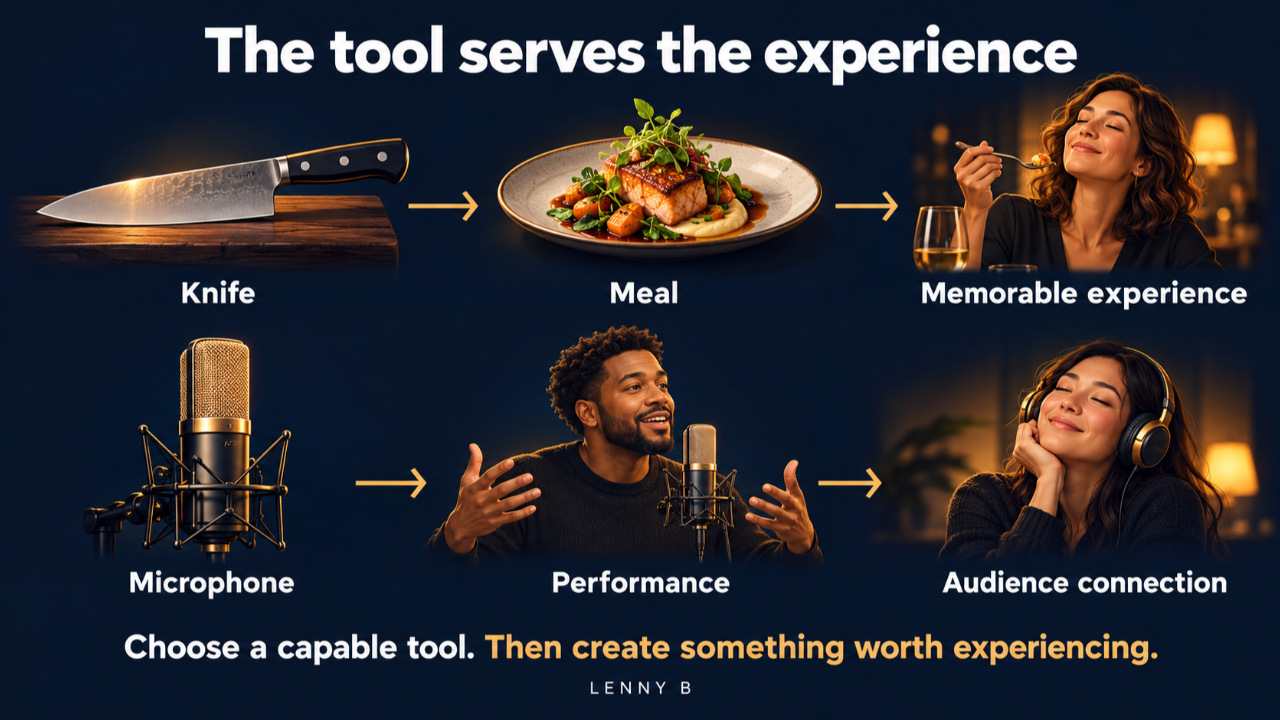
Does the knife cut the meat?
The chef needs a knife that can prepare the ingredients for the recipe. It has to do the job.
Your microphone has a job, too. Can it capture your voice clearly, without adding noise, distortion, or other artifacts that distract the listener? It needs to let the story, the meaning, and the emotion come through so your audience can focus on your message.
There is a quality threshold. Distracting noise, room reflections, or distortion can interfere with that connection. Just as a knife that can’t cut properly gets in the chef’s way, an inadequate recording setup can get in yours.
But once the tool can do the job, what are you hoping another purchase will change?
The most expensive knife might give the chef pride, enjoyment, or status among other chefs. There’s nothing wrong with appreciating a beautiful tool. But owning it doesn’t guarantee a memorable meal.
An expensive microphone can be enjoyable to own, too. That alone doesn’t make your story more engaging, your audition more believable, or your explanation more useful.
The question is whether your microphone allows you to connect with your intended audience.
“But don’t I need a professional sound to compete?”
Yes. If you’re pursuing professional work, your recordings need to meet the expectations of that work.
A chef who wants to run an exceptional restaurant needs the tools and skills to prepare an exceptional meal. You need a recording setup and workflow that can deliver suitable audio consistently.
But there’s a difference between meeting that standard and endlessly debating small differences between two capable microphones.
If you’re comparing a $1,000 microphone with a $1,200 microphone, what specific problem are you trying to solve? Price alone won’t tell you which is more suitable—or whether either will improve what your audience experiences.
The story, your delivery, and the emotion you communicate deserve at least as much attention as those equipment comparisons.
An audiobook can be technically pristine and still fail to draw you in. A podcast can sound beautiful and give you no reason to return. A compelling performance, meanwhile, can keep you listening despite an occasional breath, click, or small imperfection.
Those details still deserve appropriate attention in production. Some assignments have strict technical requirements, and those requirements matter. But removing every tiny imperfection doesn’t create the connection that makes someone care.
Restaurant guests remember how the meal and the experience made them feel. Your listeners remember what you helped them understand, imagine, or feel.
That’s what the equipment is there to support.
Choose the knife, then start cooking
A chef starts with the meal they want to prepare and chooses a suitable tool to help make it.
Start with what you want your recording to accomplish. Are you drawing someone into an audiobook, delivering an audition, teaching a viewer, or building a relationship with a podcast listener?
Then ask whether your current microphone and recording setup can support that experience.
Record something representative of the work you want to do. Listen to the recording. Is something distracting from the message? If so, identify it before deciding what to buy. The microphone may need changing, or you may need to improve the room, placement, or recording technique.
If you’re unsure whether your setup needs changing, I explain how to separate capture problems from processing problems in Do You Need Better Recording Technique, Better Processing, or Both?.
This came up during a recent consulting conversation with a client who was considering different microphones for his recording setup. We talked about what he needed the equipment to accomplish and what the person listening would actually experience. That’s an important part of how I help people: working through the recording decisions so they can move forward with more confidence.
If the knife cuts the meat, the chef can start preparing the recipe. If your setup captures a clear, suitable recording, you can start developing the performance and creating something worth listening to.
You’ll learn more about what you need as you do the work. An upgrade can follow a specific limitation you discover.
But if the chef keeps postponing dinner until he finds the perfect knife, the guests stay hungry. If he never stops comparing, the restaurant may never open.
Sometimes shopping feels safer than creating
Researching microphones can feel productive. There’s always another comparison to watch and another opinion to consider.
Recording something and putting it in front of people feels different. Now you’re making decisions about your performance. You’re finding out what connects and what needs work.
That’s where you develop.
The chef gets better by cooking, tasting, serving, and learning. You improve by recording, listening, sharing your work, and doing it again.
Enjoy the equipment. Choose it thoughtfully. Build a professional sound. Then give yourself the opportunity to improve through doing the work.
Your listener wants the story. Your viewer wants the explanation. Your potential client wants to hear what you can bring to the project.
Stop making your audience wait while you shop for knives.