What Is Voice-Over Processing?
Aug 22, 2026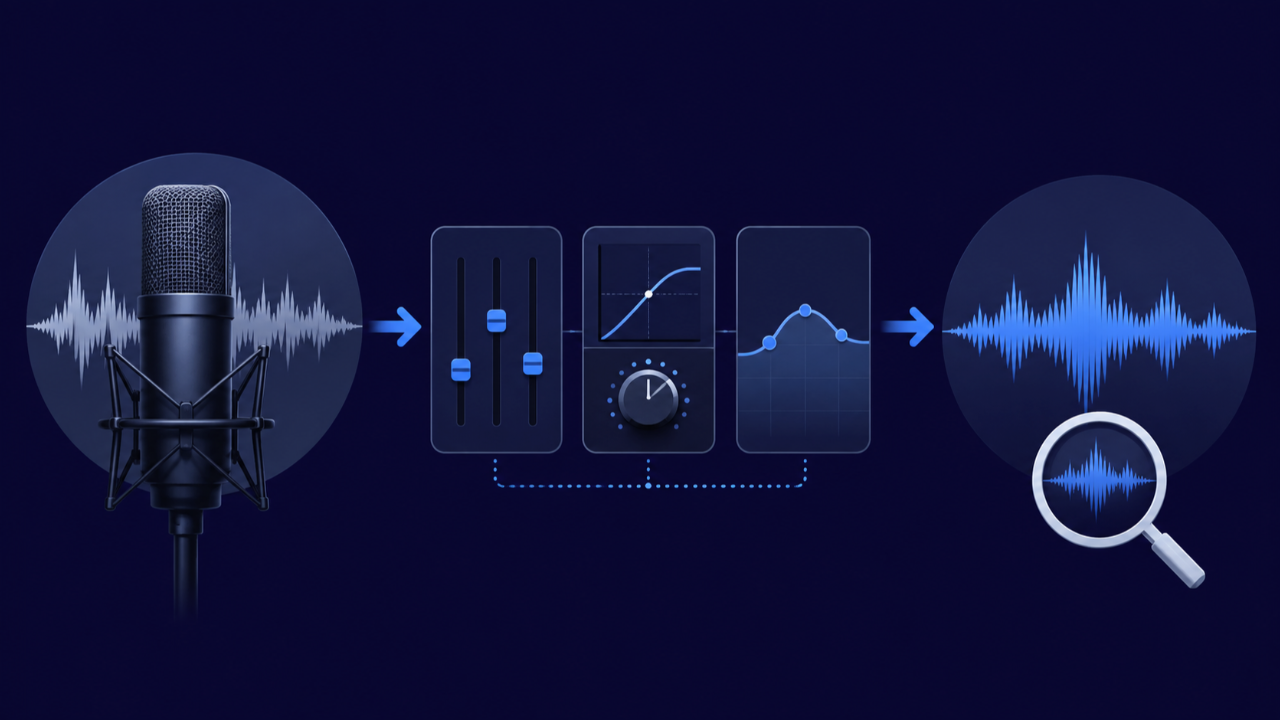
Voice-over processing is the use of audio effects such as EQ, compression, de-essing, limiting, and other processors to turn a raw voice recording into a polished, stable, and balanced final product that is easier to listen to and better prepared for delivery.
The goal is not simply to make a voice sound “better.” Good processing helps make the message easier to hear, easier to understand, and more reliable across different playback systems and listening environments.
Why Is Voice-Over Processing Used?
A raw recording may already sound good, but processing can make it more consistent and easier to consume.
One important example is frequency balance. A voice recording contains low, mid, and high frequencies, and those areas are not always naturally presented in the most balanced way. Processing can help smooth that frequency palette so the voice sounds clearer and more comfortable to listen to.
That matters because people do not always listen under ideal conditions. They may be hearing your voice through earbuds, a phone speaker, a car stereo, a laptop, or a television. They may also be distracted by traffic, other people, background noise, or competing media.
From a communication and marketing standpoint, your voice often has to compete for attention. Processing can help the message cut through that noise and remain clear enough to be understood.
The Best Processing Should Help the Listener Hear You
Voice-over artists often think about processing in competitive terms. They want their audio to sound polished enough to stand out, professional enough to avoid rejection, and strong enough that a listener will want to keep listening.
A certain level of professional audio quality is absolutely critical if you want to compete at a professional level. Your recording needs to be clean, clear, balanced, and technically reliable enough that the sound itself does not become a distraction or a reason to reject the work.
Beyond that threshold, though, I think listeners are usually far less interested in the technical quality of the processing than voice artists imagine. They are much more interested in the content, the story, the performance, and the emotional connection they feel with the person speaking.
My approach to voice-over processing is based on that idea.
I do not want the listener to hear the processing. I want them to hear you.
Good processing should help remove anything that gets between the performance and the listener. It can balance the frequency range, control distracting dynamics, reduce harshness, and make the recording more stable across different playback systems, but the goal is generally not to make the processing itself noticeable.
The exception is when you are intentionally going for a particular style or effect where the processing becomes part of the storytelling. In that case, exaggerated compression, distortion, filtering, saturation, or other audible processing may help reinforce the mood, character, or purpose of the piece.
I think of that as a different use of processing: creative effect processing rather than general-purpose voice optimization.
I think of processing as clearing the lens between the story and the listener. The cleaner that lens becomes, the easier it is for your personality, intention, and emotion to come through without the technology getting in the way.
That is especially important in voice-over because the voice is often carrying the entire message. When processing is working well, the listener should not be thinking about EQ, compression, or technical quality. They should simply be receiving the performance.
Processing Can Also Shape the Feel of a Voice
Most voice-over processing is best used transparently, but that does not mean it has to be completely neutral. Subtle processing can make a voice feel warmer, more present, smoother, more controlled, or more intimate without making the listener consciously notice the effects.
That kind of shaping can reinforce the emotion or intent of the script while still keeping the performance at the center.
A narration, commercial, audiobook, documentary, animation performance, or corporate presentation may each benefit from a slightly different sonic character.
If the processing becomes intentionally obvious, I think of that as a different category: creative effect processing. In that case, the sound of the processing itself becomes part of the storytelling.
That is why I think of voice processing as part engineering and part creative interpretation. The goal is always to support the performance rather than overpower it.
Processing Is Best Used to Optimize, Not Repair
Processing can sometimes improve a less-than-ideal recording, but in my opinion that should not be its primary job.
The best result usually begins with a well-recorded raw voice. Good microphone technique, a properly treated recording space, a sensible recording level, and a clean signal give the processing something strong to work with.
When the source recording is already good, EQ, compression, and other effects can be used to optimize the sound rather than rescue it.
That distinction is important. A processor can often reduce a problem, but it may not be able to replace the quality that would have been captured if the recording had been done correctly in the first place.
Editing and Processing Are Not the Same Thing
The words editing and processing are sometimes used interchangeably, but I think they describe two different types of audio manipulation.
Editing changes the recording in time. Using a DAW or other audio software, you can cut, copy, paste, remove, shorten, or rearrange sections of the recording. In voice-over, editing might mean removing unwanted takes, tightening long pauses, replacing a phrase, or rearranging words so the finished recording accurately reflects the script you intend to deliver.
Processing changes the sound of the recording itself. Rather than moving pieces of audio around in time, processing manipulates things such as frequency balance, amplitude, dynamics, and the level of specific frequency ranges.
That is where tools such as EQ, compression, de-essing, saturation, and limiting come into play.
In my approach to voice-over production, the distinction is simple: editing changes what is there and when it happens; processing changes how it sounds.
What Effects Are Commonly Used in Voice-Over Processing?
A typical voice-over processing chain may include several different tools.
EQ is used to adjust the tonal balance of the recording. It can reduce unwanted frequency buildup and help emphasize the more useful or pleasing parts of the voice.
Compression controls dynamics. It can help reduce the difference between louder and softer parts of the performance and can also add density, presence, or character.
De-essing helps control excessive sibilance, especially harsh “S” sounds.
Other processors may be used for saturation, limiting, gain control, or other specific purposes depending on the voice and the desired result.
The important point is that these tools work together. Their settings, order, and interaction can significantly change the final sound.
Voice-Over Processing Is Not One Universal Preset
One of the most misleading ideas in voice processing is that there is one perfect preset that works for everyone.
There is not.
A processing chain reacts to the voice, microphone, room, performance, recording level, and the quality of the raw audio being fed into it. A setting that works beautifully for one person may be completely wrong for another.
This is why professional processing involves listening and making decisions rather than simply copying numbers from someone else’s screen.
Processing and Audio Restoration Are Different
There is another category of audio processing that is often used in modern voice-over work: restoration.
Restoration tools can reduce noise, remove clicks and pops, repair certain types of distortion, and sometimes recover audio that would have been considered unusable years ago. Modern restoration technology can be extremely impressive.
But I still make an important distinction between restored audio and well-recorded audio.
Even when restoration works remarkably well, the result is often starting from compromised material. In most situations, a clean recording captured with good technique, appropriate equipment, and a controlled room will give you a better foundation than trying to repair a poor recording afterward.
Restoration is valuable when you need it. It is simply not the same thing as optimization.
The Best Voice-Over Processing Starts With the Recording
The strongest approach is to think of the entire process as a chain.
First, capture the voice properly. Then edit the recording if necessary. After that, use processing to shape, balance, and optimize the sound. Final loudness or mastering comes later.
Each stage has a different job.
When those stages are kept in the right order, processing becomes much more effective because it is improving a strong recording instead of fighting against problems that should have been solved earlier.
Want to Hear What Professional Processing Can Do for Your Voice?
If you are not sure whether your current sound needs better recording technique, better processing, or both, send me a short raw voice recording.
I’ll personally listen to it and help identify what may be affecting the sound. I can also show you what your voice can sound like with a professionally designed processing chain built around your voice, microphone, room, and recording.
There is no obligation to purchase anything.
SUBMIT YOUR AUDIO →
https://www.lennyb.com/submission