What Does Compression Do to a Voice Recording?
Aug 22, 2026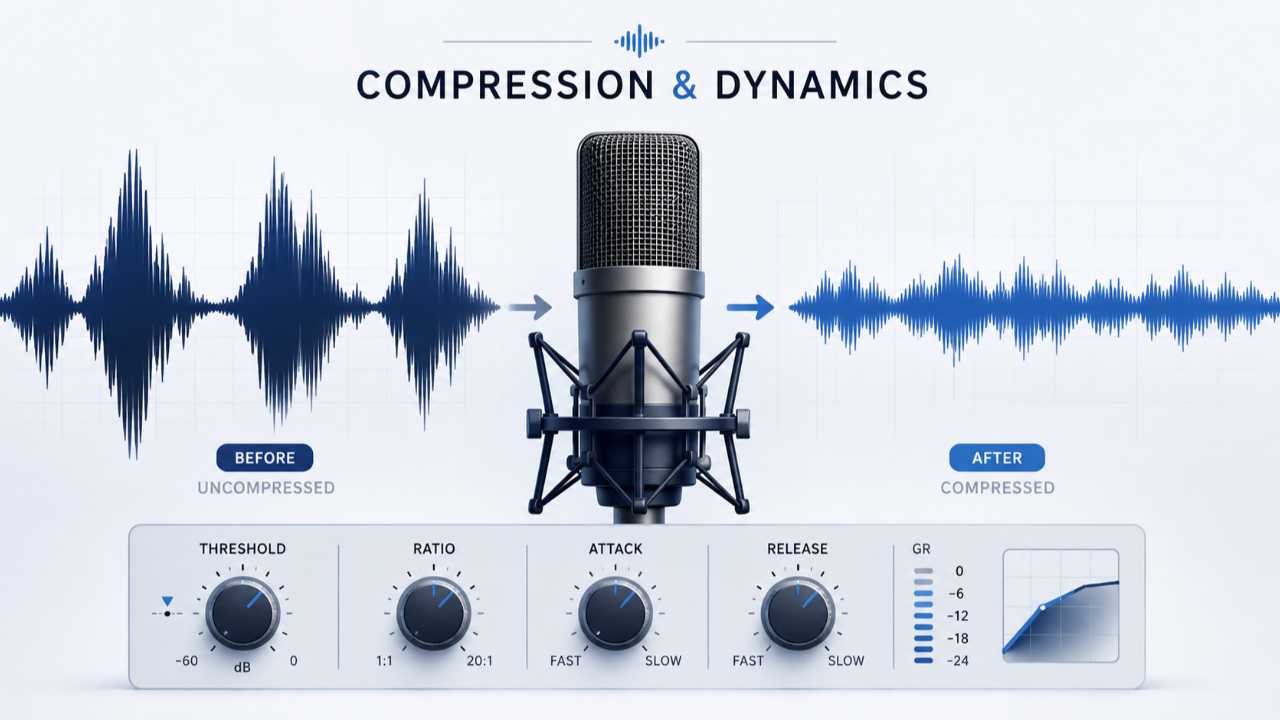
After EQ, compression is probably the second most powerful processing tool you can use to shape the sound of a voice recording. EQ changes the tonal balance of the voice, while compression changes the dynamic relationship between the louder and softer parts.
That sounds simple, but compression is one of those concepts that can become complicated very quickly. It can be used subtly or aggressively, and the result depends heavily on the material being fed into it. That is why a compressor preset can sometimes be misleading.
One of the most important things to understand is that compression works best when the raw recording is already good. If your recording has a lot of room reflections, noise, inconsistent microphone technique, or other problems, compression can actually make those problems more noticeable.
For voice-over, a good raw recording usually means the room is controlled enough that the microphone is capturing very few unwanted reflections. When the source recording is stable and clean, it becomes much easier to hear what compression is actually doing.
What Does a Compressor Actually Do?
At a basic level, a compressor reduces the difference between the louder and softer parts of a recording. You can think of it as gently reining in the dynamics.
That can happen on a large scale or a very small one. A compressor might help even out the difference between louder and softer phrases, but it can also affect the relationship between individual words, consonants, vowels, and transients within the performance.
That is one reason compression is so powerful. It is not simply making something quieter. It is changing the way the dynamics of the performance behave.
Why Compression Presets Can Be Misleading
Most compressors give you controls such as threshold, ratio, attack, release, and gain. Those controls determine when the compressor begins working, how much compression is applied, how quickly it reacts, and how quickly it returns to the uncompressed signal.
That creates an enormous number of possible results. The same compressor setting can behave very differently on a quiet conversational read, a highly projected commercial performance, a whisper, or an animation read.
So much of how a compressor behaves is dependent on the material being fed into it. That is why the idea of one universal compression preset can be misleading. The settings matter, but the voice and performance matter too.
What Can Compression Add to a Voice?
Used properly, compression can do much more than simply control volume. Depending on the compressor and how it is set, it can add thickness, consistency, warmth, slight saturation, presence, and a feeling that the voice is being pushed forward.
That can be especially useful when you want the voice to feel more polished, controlled, and present. Some compressors are modeled after famous hardware units used in music production, and those different designs can add their own character or color.
But the reverse is also true. If the original recording is poor, compression can make noise, reflections, mouth sounds, and other unpleasant details more noticeable. The better the source recording, the more useful compression becomes as an optimization tool.
Compression Should Not Replace a Good Recording
A compressor should not be your first line of defense for controlling a performance. If you are doing an ultra-dynamic read, projecting heavily, whispering, or moving through dramatically different levels, the best approach is still to capture the recording properly.
That means setting the right input gain, maintaining good microphone technique, and leaving enough headroom for the performance. Once the recording has been captured well, compression can then be used to optimize it.
In my opinion, that usually produces a better result than asking the compressor to fix a recording that should have been captured differently in the first place.
Compression Can Be Subtle or Heavy-Handed
There is no single correct amount of compression. Sometimes you may want the compressor to work so lightly that the difference is barely noticeable. Other times, heavy compression may be used intentionally to create a much more obvious sound.
Both approaches can be useful. It depends entirely on what you want the tool to do.
This is why learning compression is less about finding a magic compressor and more about understanding how the controls affect the sound. There are countless compressors available today, and many of them are capable of producing excellent results when you understand how to use them.
Compression and EQ Work Together
Compression becomes even more interesting when you combine it with other processing. EQ and compression can affect one another in important ways, and the order of the processors in a chain can change the result.
For example, an EQ placed before a compressor changes the signal the compressor reacts to. An EQ placed after a compressor changes the tone after the dynamics have already been controlled. Neither approach is automatically right or wrong; they simply create different results.
The same is true when compression is combined with de-essing, saturation, limiting, and other processors. Even when you are working with only one voice, the interaction between these tools can become surprisingly sophisticated.
The Best Way to Learn Compression
My suggestion is simple: find a basic compressor and experiment with it on a clean voice recording. Turn the controls much farther than you normally would and listen to what happens.
Try a very fast attack and then a very slow one. Do the same with the release. Try extreme ratios, move the threshold around, and listen to how the voice changes.
You really cannot break anything by experimenting in the digital domain. That is how I learned. At first, the differences may be difficult to hear, but the more you use compression, the easier it becomes to recognize what the controls are doing and how those changes affect the sound.
Eventually, the goal is to hear what you want and understand how to use the tool to get there.
Want Help With Compression and Dynamics?
Some people enjoy learning how compression works and want to develop the skill themselves. Others would rather have a professional help them understand the tool or build the processing so they can focus on performing.
If you want to learn how to use compression and dynamics more confidently, tell me what you are working on and I can help you determine whether a private coaching session makes sense.
Want to Hear What Your Voice Sounds Like With Professional Processing?
If you would rather not worry about compression, EQ, and the rest of the processing chain yourself, send me a short raw recording. I’ll personally review it and show you what your voice can sound like with a professionally designed processing chain, including compression tailored to your voice, microphone, room, and recording.
There is no obligation to purchase anything.