The Order Matters: Why Modern Marketing Starts Differently
Aug 20, 2026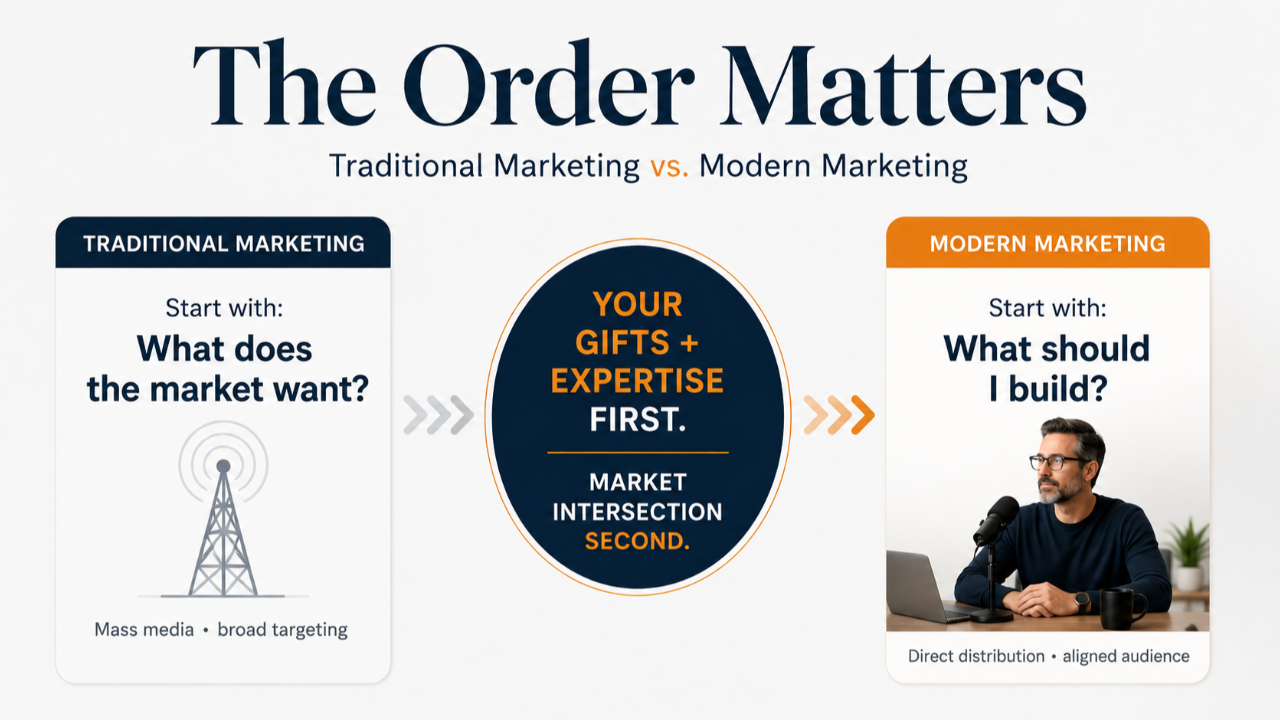
I spend a lot of time helping content creators and people creating content with their voice to attract, grow, and retain an audience of ideal customers. Sometimes the problem is technical—sound quality, microphones, processing, workflow, or mastering. Other times it’s messaging, positioning, content, business direction, or marketing.
Increasingly, I’ve noticed that the technical and business sides are connected.
Recently, I had an early business and marketing conversation with an extremely experienced former CEO. This wasn’t someone unfamiliar with business. He had spent decades leading companies, making decisions, building organizations, and understanding how businesses operate.
But he was entering a different chapter of his life. He had a passion for VoiceOver and wanted to explore how he might build a meaningful business around it.
During one of our first conversations, something interesting happened: he realized he might be approaching the entire problem backwards.
The Traditional Question
His instinct was completely reasonable: What does the market want?
What kinds of VoiceOver are companies buying? Where is the demand? What niches are growing? What should he offer? Those are legitimate questions, and they are also questions generations of businesspeople have been trained to ask.
For much of modern business history, that approach made enormous sense because marketing and distribution were expensive. If you wanted to reach people, you bought television, radio, newspaper, magazine, direct mail, billboards, or other forms of mass distribution. You generally needed a sufficiently large market to justify the cost of reaching it.
So businesses naturally started with:
What does the market want, and how can we build something enough people will buy?
But the world has changed.
Distribution Changed. Marketing Changed With It.
Today, an individual can publish a video globally through YouTube, build a website around an extremely specific area of expertise, create a podcast, publish articles that appear in search results for years, build an email audience, and reach highly specialized communities through search, video, social platforms, and niche channels.
Much of that distribution is free—or dramatically less expensive than the broadcast model I grew up working in.
That changes what is possible.
You no longer necessarily have to begin by asking:
What does the largest available market want?
There may be a better first question:
What do I actually want to build?
And then:
What am I unusually qualified to build?
You Don’t Have to Be Everything to Everybody
This became particularly important in our conversation about VoiceOver.
A common way to approach the VoiceOver business is to become as versatile as possible, audition constantly, and try to fit whatever a particular client happens to need: commercials, narration, corporate work, e-learning, audiobooks, characters, medical, technical, and everything in between.
There is nothing inherently wrong with that business model.
But there is another possibility.
Instead of asking:
What kind of VoiceOver Artist does the market want me to become?
we started asking something very different:
How do I package and market the business experience, specialized knowledge, communication skills, and judgment I’ve refined over decades—and tell that story so the right people actively seek me out?
That changed the conversation.
Because he wasn’t merely a man with a good voice. He had decades of business experience. He understood executives, organizations, decision-making, communication, and how businesspeople speak to other businesspeople.
Why should all of that disappear the moment he steps behind a microphone?
Your Experience Can Be Part of the Product
Imagine two VoiceOver Artists reading material intended for senior business leaders. Both have strong voices, and both can technically perform the script.
But one of them has spent decades sitting in the rooms the script is talking about. He understands the language, the audience, and what executives are trying to communicate because he has been one.
Now the decision is no longer simply:
Which voice do I like better?
The positioning becomes:
Which person understands what we are actually trying to say?
That is a very different kind of value.
You are no longer just selling a voice. You are positioning yourself as a knowledgeable colleague who also happens to be an excellent VoiceOver Artist. Your experience, judgment, specialization, and credibility become part of the product.
And that can be marketed.
What If You Hired Yourself?
This may have been the most interesting realization of the conversation.
A VoiceOver Artist normally waits for someone else to hire them. But what if you built something of your own—a product, service, educational business, media property, consulting practice, or specialized content brand?
Then suddenly your VoiceOver ability becomes one of the tools you use to promote your own business.
Instead of continually asking other people to choose you, you get to choose what you want to build.
You hire yourself.
Your voice becomes part of a larger collection of assets: your experience, knowledge, personality, perspective, interests, credibility, relationships, communication ability, and natural gifts.
Then marketing has a different job. It is not trying to make you appealing to everybody. It is helping the people who already value those particular strengths find you.
This Goes Beyond VoiceOver
The same principle applies to many people creating content with their voice.
A coach may think they need to imitate the marketing of every other coach. A YouTube creator may chase whatever topic appears to be getting the most views. A podcaster may try to broaden the show until it appeals to everybody. A business owner may spend years producing generic content because they think that is what marketing is supposed to look like.
Modern distribution gives us another option.
You can become more specific, more useful, more recognizable, and more yourself.
Your experience, expertise, point of view, communication style, and even the way you sound can become part of why the right audience chooses you.
The goal is not simply to build a bigger audience.
The goal is to attract, grow, and retain an audience of ideal customers—people who recognize the particular value you bring.
The Market Still Matters
This does not mean ignoring the market.
You still have to determine whether people value what you want to create. You still need to understand customers, positioning, messaging, pricing, offers, distribution, and sales.
But the order matters.
Instead of immediately asking, “What does everybody else want me to become?” you can begin by asking what you want to create, what you are naturally equipped to do exceptionally well, what experience or expertise you already have that others may value, and who would find that combination unusually useful.
Then you look for the intersection between your abilities, your interests, your experience, a real problem, a specific group of people, and an economically valuable solution.
That intersection is where I believe some of the most interesting modern businesses can be built.
A Different Kind of Marketing
The breakthrough in this conversation was not that we had suddenly discovered his perfect business. We hadn’t. This was still very early.
The breakthrough was more fundamental.
A tremendously experienced businessperson realized that the business environment had changed enough that an old, perfectly rational way of thinking might no longer be the best place to start.
He did not necessarily need to run around trying to become everything every possible VoiceOver client might want. He could decide what he wanted his next chapter to look like, identify the experience and abilities he had spent a lifetime developing, package those strengths into something valuable, and then use modern marketing to help the right people discover it.
That is a very different relationship with the market.
And for the right person, it can be an incredibly freeing one.
The Order Matters
Traditional marketing often started with:
What does the market want?
Modern marketing gives us the ability to ask something more personal and potentially more powerful:
What should I build from the gifts, experience, expertise, and strengths I already have—and who is the right audience for it?
The market still matters.
But the order can change.
And sometimes, changing the order changes everything.